

Palestinian Prisoner Remembrance Day
Bearing witness & invite to join Lubna and me + sangha on 4/17

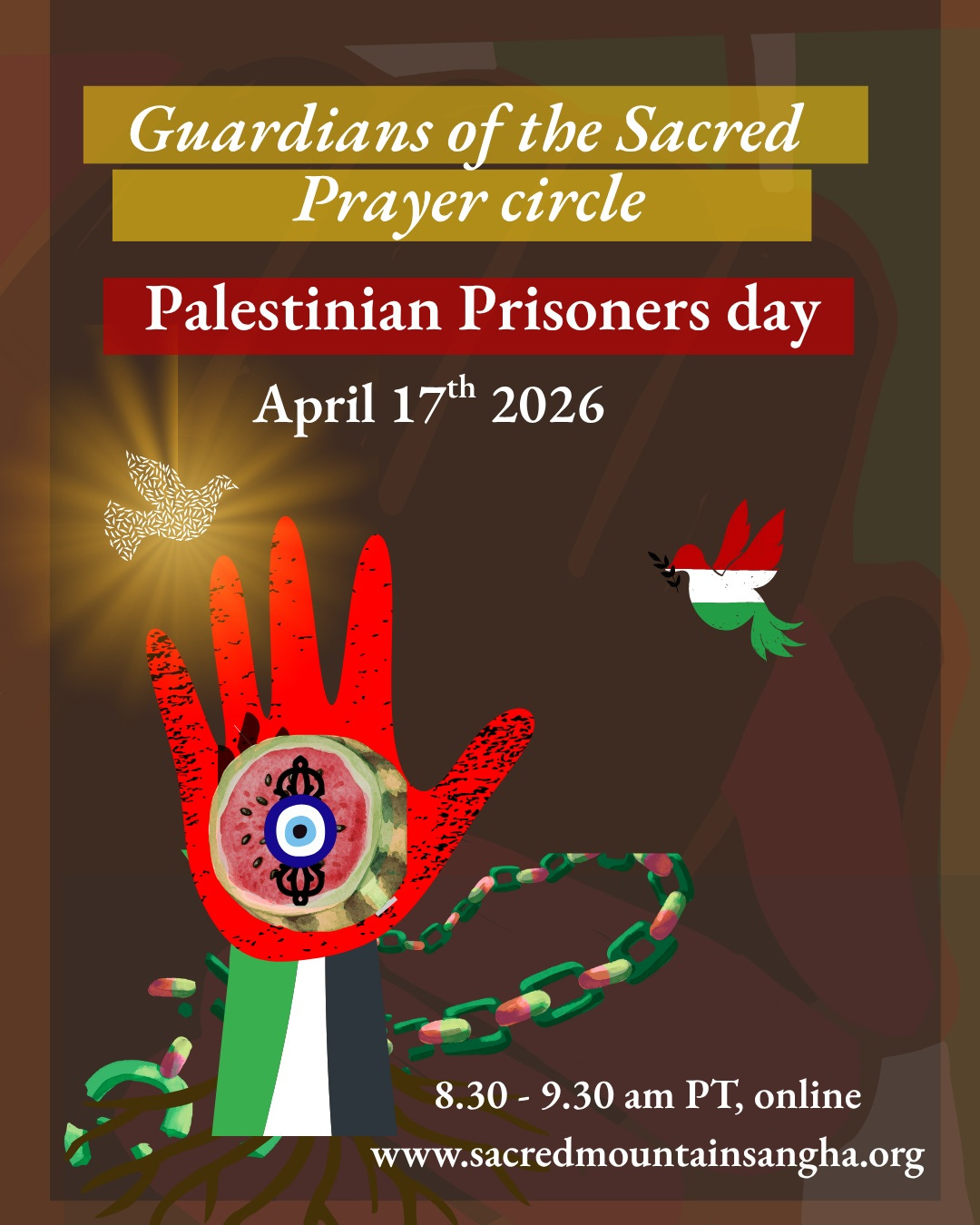
Join us, with our dear friend and sangha member, Lubna Masarwa, calling in from Palestine, on April 17th, at 8.30 am - 9.30 am PT, for our special Guardians of the Sacred Palestine Prisoners Remembrance Day. We’ll be highlighting Lubna’s sharing + offering protection chants. Read more about Lubna & her work here, including her articles for Middle East Eye.
April 17th is Palestinian Prisoner Remembrance Day. A day that has become personal to me because a few months ago, I was in the West Bank listening to the stories of families whose young sons had been taken, imprisoned, and killed, without trial, reason, or representation, in Israeli prisons.
I’d been invited by a Palestinian friend to spend time with them in Palestine, a world far, far beyond Israel. A world that flows and travels along potholed roads, ubiquitous dirt tracks, and under tunnels over which Israel’s network of freeways dominates. A world of high walls, constant and insidious surveillance, and a life controlled by erratic checkpoints, where danger, chaos, frustration, and anger circulate.
And a world where drivers track a crackling car radio, tuning into the ever-changing impossible logic of when the IDF decides to open or close borders. No rationale, and no timeline, only lost hours, days, sometimes weeks, as plans to get to work, to the hospital, to see friends, are waylaid or abandoned.
A world where the ancient rolling lands of villages, olive trees, farms, and footpaths are harshly scarred by monstrous, grey, looming walls and watch towers, caging in millions who are constantly navigating the overarching daily impacts of violent state control. Villages, communities, and families are brutally cut off from one another in cul-de-sacs and ghettos, going nowhere; in places that were once thriving towns and markets, filled with people moving freely through their daily lives.
Instead, this world of menacing walls and high razor-sharp tangled fences is a giant prison; a maze of scars echoing deep emotional and psychological wounds inflicted by a system of control that feels relentless and which acts with utter impunity. A regime that can barrel into the streets in armored vehicles at any time, as happened when I was there as dusk fell. I thought we had driven into a fog, but then realized it was tear gas through which dark, ominous shapes that looked more like strange, helmeted monsters than human beings, had free rein to terrorize and round up people who were just trying to get home.
This is a world where a group of soldiers can crash into any family home and grab a young son, intimidating and gaslighting parents, giving them a false choice that transfers blame and guilt as they demand, “either we bomb you, or you give your son to us.”
A world where a son, as he’s taken away, turns to look directly at his mother. She understands, from the look in his eyes, that she will not see him again. A world where a mother can never forgive herself for letting him go.
A world where a proud, hard-working father, trying to be brave for his young children, quietly fractures into a thousand shards when no one is looking. A world where injustice is so profound that it literally changes the DNA of those subjected to its vacant crushing pain into an eternal vow of pure resistance.
But better to hear directly from my Palestinian friend, Lubna Masarwa, a person with a fearless spirit, authenticity, and a keen appreciation of beauty, humor, and life. One whose heart’s pulse is her unswerving service and alliance with her people. Lubna, who is based in Jerusalem, is a fellow dharma practitioner and teacher and a peerless lead journalist for Middle East Eye.
Lubna, a “48 Palestinian,” has been reporting on the fate of Palestinian prisoners and their families, tracking the horrors they face and the long-lasting impacts they endure. Witnessing Lubna hear the story of the families we visited, whose soulful young sons had been killed, was not just witnessing a reporter. It was being in the presence of a sacred exchange, facilitated by the depth of presence, listening, care, and compassion that Lubna embodies.
Lubna’s articles don’t only record the stories of young sons taken, never to return. In February of this year, Lubna broke a story, told by two former prisoners, of a heinous form of torture that, besides the extreme beatings, exposed the vile sexual torture of rape by dogs. This is something beyond all comprehension. Truly, it is hard not to feel as if something deeply inhuman is moving through these spaces.
If you have the stamina, here’s the article based on Lubna’s work documenting this savage abuse of Palestinian prisoners. But please be aware, this article contains graphic and distressing accounts of rape and sexual abuse. It’s a harrowing interview and read.
These brutal acts of rape, causing extreme bodily harm, which often lead to death, are now well documented. Also well documented is the lionization of the IDF's rape of Palestinians within Israeli society. What we’re witnessing here is something profoundly broken and ethically bankrupt. This is a society where the majority, as also documented, cheer on these extreme and unnatural abuses.
For the Palestinians, however, these horrific acts of dehumanization usually remain unspoken because they evoke deep shame. Unfortunately, this in turn cements severe trauma through silence. Lifting that silence, therefore, is central to demanding human rights for Palestinian prisoners, which is why Palestinian Prisoner Remembrance Day is so important.
I’ve found it hard to know where to tell this story, as engaging these endless crimes against humanity is arduous and takes a toll. But that pales in the face of such evil, which is even more reason to honor Lubna’s courage in making the journey, both inwardly and outwardly, to meet survivors so she could listen to and record what they endured.
It is also important to understand that these are not isolated stories, but part of a documented system of “administrative detention,” which is a quasi-legal term that “allows” people to be abducted and held indefinitely as political prisoners, who are then denied trial, representation, formal charges, legal clarity, or a clear sentence.
9,600+ Palestinian political prisoners are currently held in captivity.
3,500+ under administrative detention, imprisoned without charge or trial
350+ children detained, with hundreds prosecuted yearly in military courts
Reports of night raids, blindfolding, coercive interrogation, and torture
Sexual violence, including rape, has been documented in recent testimonies
Deaths in custody are increasing, often linked to neglect or abuse
Withholding bodies of hundreds of Palestinians, sometimes for years or decades
Expanding the death penalty, which has 96% conviction rate.This is not only a Palestinian issue, but also an urgent human rights issue.
What struck me when Lubna spoke to me about the process of these interviews was her own experience of being so profoundly moved by the depth of dignity the men maintained. She also talked about how, despite what had happened, she experienced a rare and profound sense of peace in their presence.
This reflects a depth of faith, family, and community that is more enduring than the pain inflicted. This quality of spirit I experienced throughout my very short time in Palestine. Everywhere I went, whether bearing witness to the immense loss of families enduring numerous violations, or in crowded coffee shops, vibrant market stalls, and restaurants serving traditional fare, I experienced a community with dignity, grace, instinctive generosity, warmth, and friendliness.
The young brother, a small boy, at the first family home we visited, offered pieces of the chocolate bar we gave him to everyone in the room. The uncle from that same family who caught us just before we drove away, because he wanted to offer us the sweetest dates. The elderly farmer whose family cooked us a meal, who offered endless fruit, nuts, honey, and gifts, and who delighted us with a long, winding story about the miraculous lives of bees, as we consumed small cups of strong coffee.
I don’t want to romanticize the enormous struggle to survive Israel’s brutal Apartheid state. But to highlight that community, connection, sharing, and inclusion feel more alive and real on the Palestinian side of the Apartheid wall than the side we usually swim in, which is this often soulless world of modernity. But it is also searingly true that this long occupation not only brutalizes physically, it is also ruinous and desolating in its aim to continually shatter the possibility of a more normal life.
There’s nothing normal or easy for Palestinians under occupation. However, I want to share with you one of Lubna’s humorous tactics for managing the extreme stress and lunacy of waiting at the ubiquitous checkpoints. While I was seriously reciting mantras, Lubna would open the window, turn up the volume on her car radio, and blast out Louis Armstrong’s “What a wonderful world,” or her favorite Frank Sinatra's. I particularly loved the mirthfully subversive, “I’ll do it my way!”
Even as I write this, I’m still laughing at how crazy can transform into unexpected crazy delights. I learned with Lubna that there’s no use making a plan beyond the next short while. (Just do it!) And I learned, too, how suffering and joy, pain and beauty, are so closely intertwined. As I write this, I am also learning how difficult it is to adequately convey the immensity of wrongs that should long ago have been held accountable.
The only way I can really write something about the agonizing situation of Palestinian prisoners is to admit that I will fail. I fail to do right by those suffering this grave injustice. I fail to adequately articulate the depth of depravity that’s happening every day to the tens of thousands hidden away. And, I fail those who have been cut off from the possibility of a more humane life just because they are born as Palestinians.
Perhaps we have all failed. These stories mirror the historic way prisons function as repositories of our unconscious underworld. We’d rather throw away the key to those locked underground than understand and undo the causes that created prisoners in the first place. In the case of Israel’s military prisons, they function as spaces where hatred is transformed into acts of unimaginable and unaccountable sadism and violence, which inevitably emerge within systems of occupation and colonial control.
What is important to flag here is what many of us predicted: that all unfolding in Gaza did not stay in Gaza. Instead, as Aaron Bushnell predicted, it’s “What our ruling class has decided will be normal.”
We now see echoes of this logic beyond the walls of Palestine. In the U.S., detention camps are expanding sharply, with rising deaths, documented medical neglect, and the prolonged detention of children. While these systems are not identical, they reveal how quickly the normalization of detention, lawlessness, and dehumanization takes root across different contexts. History repeatedly shows where this leads. We are staring at our own future, as unaccountable power consolidates itself by crushing dissent, dismantling democracy, and trashing guardrails that uphold humane values.
However, history also reminds us that such trajectories are not inevitable. Across the world, people continue to rise, to organize, and to resist. This is where hope lives, not in denial, but in the ongoing refusal to accept a world built on domination and fear. This is why international law matters. Institutions such as the International Criminal Court and the International Court of Justice exist to hold the line, to insist that no state and no leader stands above the law.
We have seen, again and again, that sustained public resistance can shift even deeply entrenched systems of power. What’s important here is to remember that people have the power to change the system. Therefore, we must use that power. This is also when we remember, once again, Mr. Mandela, who said, “We know too well that our freedom is incomplete without the freedom of the Palestinians.”
The Buddha taught that “all beings fear violence, tremble before death, and love life.” Systems that forget this not only harm those within them, but they also erode the humanity of everyone they touch. To include those who are imprisoned, and even those caught in cycles of hatred and harm, within our field of mindful awareness is not to excuse what is happening, but to refuse the further dehumanization that makes it possible.
Doing all we can to dismantle systems that birth such depravity is the keystone to the broader struggle for justice; for Palestinian prisoners, for Palestine, and for all those working toward a world where dignity and human rights are not conditional, but universally upheld and protected. May it be so!
Further Info & Resources:
Lubna’s Articles in Middle East Eye
Addameer Prisoner Support & Human Rights Assoc.
Defense of Children International - Palestine
Welcome to Hell: The Israeli Prison System & Network of Torture Camps, B’Tselem (Israeli Information Center for Human Rights in the Occupied Territories).
Actions to Take:
Bear Witness Publicly
–Share testimonies and reporting (e.g., Lubna Masarwa’s work)
–Post names, stories, or key facts about Palestinian prisoners
–Use your platforms to break the silence and amplify truth
Contact Representatives
Call or email elected officials and demand:
–an end to administrative detention
–accountability for torture and deaths in custody
–protection of children under international law
Keep it simple, even one message
Join or Organize a Vigil / Gathering
–Attend local events marking the day
–Hold a small circle, vigil, or meditation
–Read names or testimonies aloud
Support Trusted Organizations
Support groups working on prisoner rights and legal advocacy, like:
–Addameer Prisoner Support and Human Rights Association
–Defense for Children International – Palestine
Even small contributions sustain long-term work
Write & Witness Creatively
–Write a short reflection, poem, or prayer
–Dedicate your practice to those imprisoned
–Share in community spaces
Stay Informed & Resist Numbness
–Read beyond headlines
–Follow journalists on the ground
–Stay in relationship with the truth, without shutting down
Link Struggles Thoughtfully
–Support movements addressing detention, incarceration, and human rights globally
–Build awareness of how these systems connect, without collapsing differences
This strengthens solidarity & connects Palestinian liberation to our greater struggle
There is no single way to respond, but to do nothing is also a response. On Palestine Prisoner Remembrance Day, and beyond, even small acts of witnessing, speaking, gathering, and supporting become part of our larger field of care and resistance. With deep gratitude.
Hi dear Thanissara,
Thank you for writing this. Bearing witness to the sacrifice of Palestinian prisoners, and generally what people in Palestine and Lebanon particularly in the South and beyond, bearing witness as in to really sit with it, is so difficult for me. I think that's why walking meditation has become such an important practice for me- movement helps with the distress.
My mind also grasps towards solidity in reading facts, knowledge, deeper understanding which maybe is a form of bypassing the bearing witness, but defenses, particularly wholesome ones I think are sometimes ok and necessary.
I've been doing some very brief googling the role of the death penalty as a tool of apartheid in the Deep South of the US where I reside as well as in apartheid South Africa..
The death penalty law recently passed for Palestinians is unique in comparison to the US and S Africa in how blatant of an apartheid law it is- ONLY for Palestinians, and ONLY if they are accused of killing an Israeli (not sure if they mean Israeli citizen (which could include Palestinians/migrants?) or just Jewish Israelis). This feels like a point of opening to talk about Israel today with others outside our spheres as well as very important within our own borders as the US has increased the executions on a wild, cruel, horrific level the past few years.
I'm sharing some of the links from my brief googles in case anyone is interested.
https://racistroots.org/section-2/
https://vc.bridgew.edu/cgi/viewcontent.cgi?article=1223&context=undergrad_rev
https://www.saha.org.za/youth_on_death_row.htm
https://www.justice.gov.za/trc/media/1997/9707/s970722b.htm
https://www.scielo.org.za/scielo.php?script=sci_arttext&pid=S0259-01902018000100008
Thank you Thanissara. Big respect and appreciation for your work. I can't join you Friday but feel so grateful for this meeting happening.